
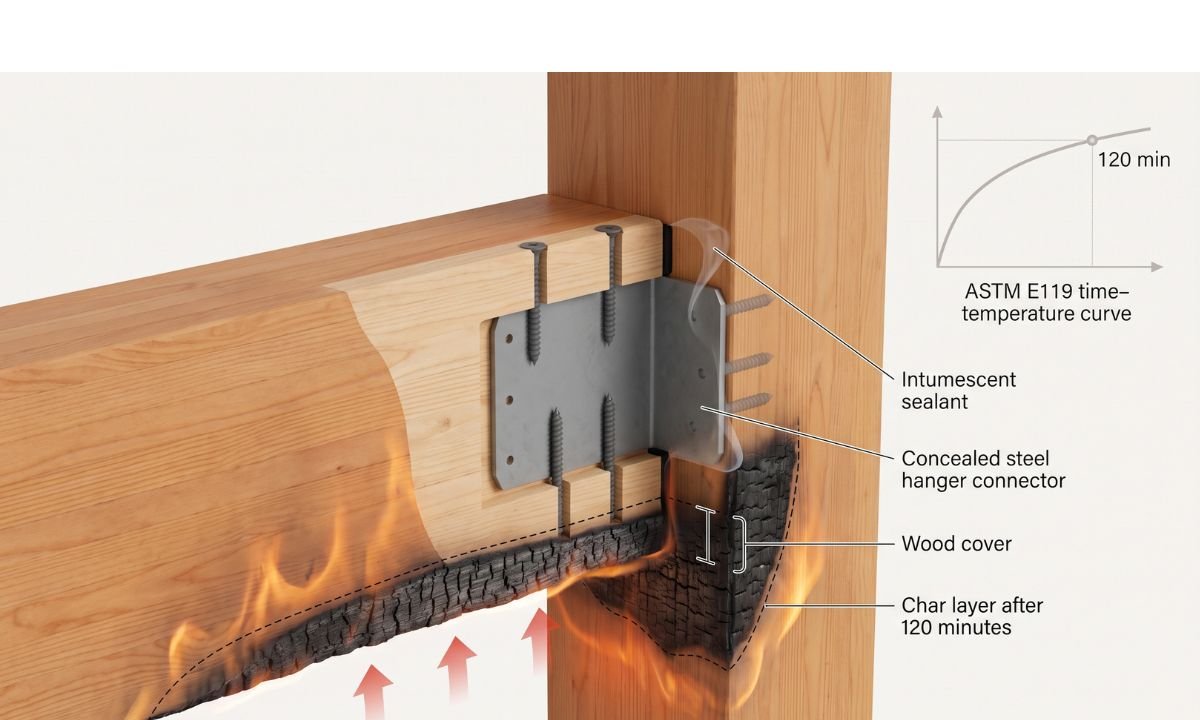
When a spec calls for a “two-hour connector,” code officials judge the whole assembly (beam, column, screws, gap treatment, and wood cover), not a lone steel plate. That’s why we ranked seven heavy timber connector makers by the fire evidence they make public, so you can drop proof into your submittals and move through AHJ review faster.
What “two-hour fire-rated connector” really means
A connector earns 120 minutes only when it is tested as part of a complete assembly: beam, column, screws, wood cover, and the beam-to-column gap detail together. Change one of those details and the tested rating may no longer apply.
Fire labs load the beams, run the ASTM E119 or UL 263 time-temperature curve (CAN/ULC-S101 in Canada), and confirm the joint still carries its load at the 120-minute mark. Failure comes when charring eats into the wood cover, heated screws lose strength, or hot gases get into an unsealed gap and reach the metal.
In short, test paperwork, not marketing copy, proves a connector’s fire endurance. Simpson Strong-Tie, for instance, posts a 140-page summary of the ASTM E119 testing for its CBH concealed beam hanger, prepared by Arup, with the Southwest Research Institute (SwRI) test reports attached, in its online technical library. Attaching a report like that to your submittal can head off the RFI back-and-forth that stalls permit review.
How we ranked heavy timber connector manufacturers
We scored each brand on six weighted criteria that matter during permit review:
| Criterion | Weight | What we looked for |
| Public 120-min furnace test | 30% | Downloadable ASTM E119, UL 263, or CAN/ULC-S101 results |
| Fire-specific documentation depth | 25% | Clear link between structural approvals (ICC-ES, ETA) and fire evidence |
| Product family breadth | 15% | Connectors, screws, and details that share design rules |
| Availability and logistics | 10% | North American manufacturing and distribution |
| Innovation | 10% | Simpler gap detailing, drift testing |
| Engineering and field support | 10% | Design guides, technical teams, inspector tools |
Calculation-only routes or request-only summaries scored lower, because they shift engineering effort onto your team.
Heavy timber connector manufacturers at a glance
Here’s a quick-reference grid so you can see who publishes public 120-minute evidence and which route backs the claim.
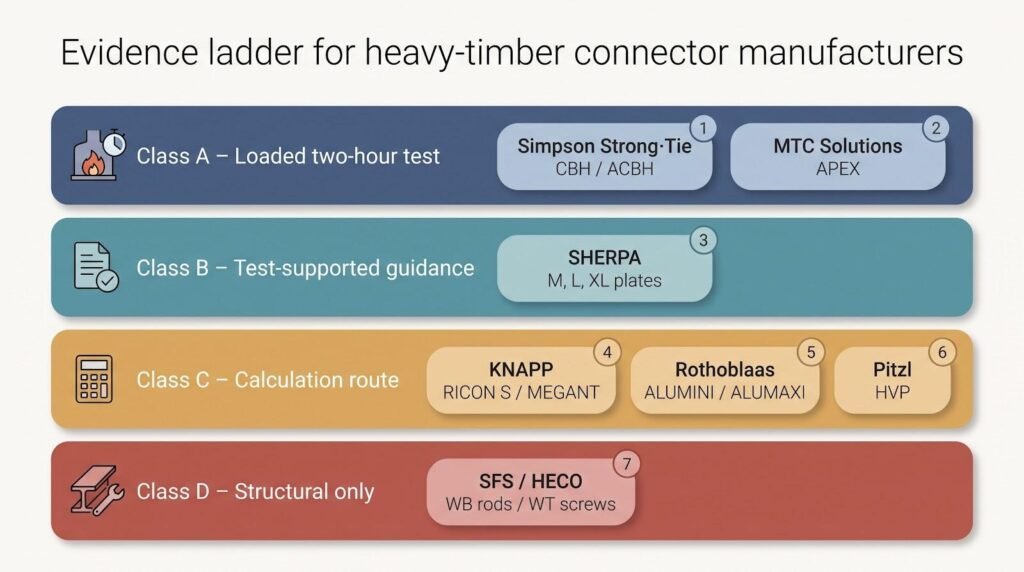
| Rank | Manufacturer | Flagship connector | Evidence class* | Fire route | One-line takeaway |
| 1 | Simpson Strong-Tie | CBH / ACBH / SCBH / HSKP | A | ASTM E119 | Deepest public North American furnace data |
| 2 | MTC Solutions | APEX | A | ASTM E119 / CAN/ULC-S101 | Tested with a gap up to 1/8 in. and no fire sealant |
| 3 | SHERPA | Aluminum connector plates | B | European approval with R120 provisions | Euro route; agree with the AHJ early |
| 4 | KNAPP | RICON S / MEGANT | C | Calculation | No public two-hour furnace report found |
| 5 | Rothoblaas | ALUMINI / ALUMAXI | C | Calculation | Broad range, no public 120-min test found |
| 6 | Pitzl | HVP | C | Calculation | Protected-connection design route |
| 7 | SFS / HECO | Threaded rods and screws | D | Structural only | Fastener approvals, not assembly fire ratings |
*Our evidence ladder: A = public loaded two-hour test, B = approval-based fire guidance, C = calculation route, D = structural approvals only.
1. Simpson Strong-Tie: deepest public North American fire-test package
Backed by 70 years of research and a broad catalog of heavy timber frame connectors, Simpson’s concealed beam hangers set the North American benchmark for two-hour data.
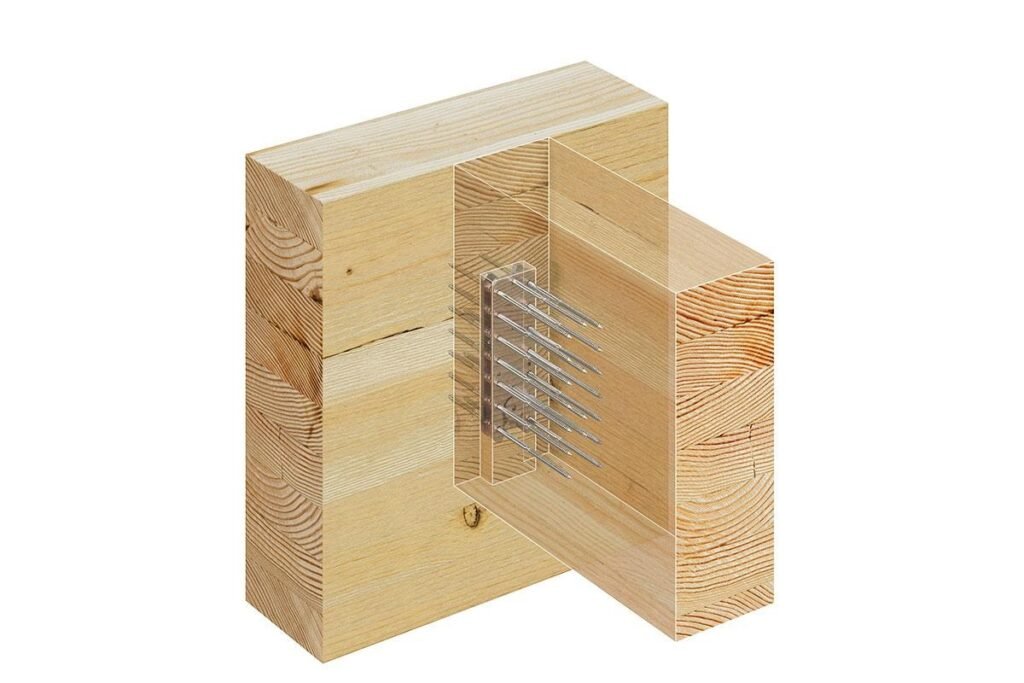
Simpson Strong-Tie CBH concealed beam hanger in a glulam connection
Flagship connectors and the tests behind them
In July 2020, SwRI ran four loaded ASTM E119 tests on the CBH concealed beam hanger:
- a single CBH carried 9,000 lb at the connector and reached a 2-hour rating
- a four-CBH connection carried 36,000 lb and also reached 2 hours
- two more tests confirmed 1-hour ratings
The CBH is code-listed under ICC-ES ESR-2552, installs with Simpson’s SDS Heavy-Duty Connector screws, and is drift-tested. The aluminum ACBH (up to 20 kips ASD) and the steel SCBH also carry 1- and 2-hour ratings per ASTM E119, and the HSKP heavy seated knife plate (ICC listed for 22 to 32 kips) achieves a two-hour rating with its hidden end-grain connection.
Fire details that keep the rating intact
The CBH summary report spells out what was tested, so you can match it:
- timber cover of 3.7 in. (single hanger) and 3.2 in. (four hangers) from the beam side and bottom to the connector
- a single line of 1/2-in.-wide 3M Expantrol E-FIS intumescent seal routed into the column face, 1/2 in. inside the beam edges
- glulam beam and column specimens of spruce-pine-fir, loaded to Douglas fir-larch values, so the results cover both species
The report’s conclusion is clear: keep the beam-to-column gap to a minimum and use an intumescent seal to stop hot gases reaching the connector.
Procurement
Standard CBH sizes are sold through Simpson’s dealer network, and the product page links the ESR, catalog pages, and the fire testing summary. Simpson offers downloadable two-hour proof, drift testing, and a family of hangers that share one fastener system, which places it at the top of our transparency ranking.
2. MTC Solutions: APEX, the no-sealant challenger
MTC Solutions also sells KNAPP’s RICON S and MEGANT connectors, but its own flagship is APEX, an aluminum concealed beam hanger engineered and manufactured in the United States and Canada. APEX is ICC-ES certified (ESR-5466), and its four models carry 23.4 to 39 kips (ASD), or up to 316 kN (LSD).
MTC says APEX reached a 2-hour fire-resistance rating in a fully loaded, full-frame test under CAN/ULC-S101 and ASTM E119, with a beam-to-column gap of up to 1/8 in. and no intumescent tape or fire caulking. In drift testing in the 2-hour configuration, the hangers withstood drift ratios greater than 6 percent without sudden loss of load-carrying capacity.
Choose APEX when you want two-hour evidence without a gap sealant, for example on mid- to high-rise glulam frames where you want fewer field variables.
3. SHERPA: European R120 route with clear gap rules
SHERPA’s aluminum connector plates are covered by European Technical Assessment ETA-12/0067, which includes provisions for R120 fire resistance, such as SHERPA Fire Stop protection strips, minimum screw lengths, and larger cross-sections. When the connector is milled into the beam, a joint gap of up to 5 mm needs no extra protection.
Because the rating comes from a European approval, not an ASTM E119 report, many North American AHJs will want an engineer’s letter that explains how it applies. Line up that paperwork early.
4. KNAPP: calculation route with strong structural approvals
KNAPP’s RICON S (steel) and MEGANT (aluminum) hook-and-slot connectors are made in Austria and install flush with the timber face. We did not find a public loaded two-hour furnace report for either, so fire design relies on calculation: added wood cover, the right species, and, where needed, encapsulation. The upside is flexibility, since you can adjust cover depth to reach different ratings without changing connector families. Plan for a stamped calculation or an alternative-means request when your AHJ expects a two-hour test.
5. Rothoblaas: broad ecosystem, thin two-hour transparency
Rothoblaas sells a wide catalog for mass timber, including ALUMINI and ALUMAXI concealed hangers and VGZ screws, backed by European approvals for structural capacity. We did not find a public, loaded 120-minute furnace report for its concealed hangers, so two hours means added wood cover, gypsum, or a project-specific test. The upside is one vendor for connectors and screws; plan extra engineering hours to show the AHJ how each joint reaches two hours.
6. Pitzl: protected-connection calculation route
Pitzl’s HVP connectors sit recessed in a routed pocket in the beam and are fixed with self-tapping screws. For two hours, designers use the protected-connection approach: enough wood cover around the connector, a filled or protected pocket, and a char-depth check on screw embedment. We found no public loaded two-hour furnace test, so budget time for the calculation and a fire engineer’s review.
7. SFS / HECO: screws that make timber-to-timber joints work
SFS, the majority owner of HECO, supplies fully threaded rods and screws (including HECO-TOPIX) with European and North American structural approvals. Those approvals cover screw capacity, not a two-hour rating for a complete beam-to-column joint.
Two hours comes from the joint design instead. In a notched, wood-bearing joint, the load passes through timber, so the screws only need enough embedment behind the char layer. Fire design becomes a char-depth check, which suits projects that want no visible plates and no intumescent tape.
Which connector types are easiest to detail for two hours?
Fire design favors joints that keep metal away from the heat source. Here’s the practical hierarchy:
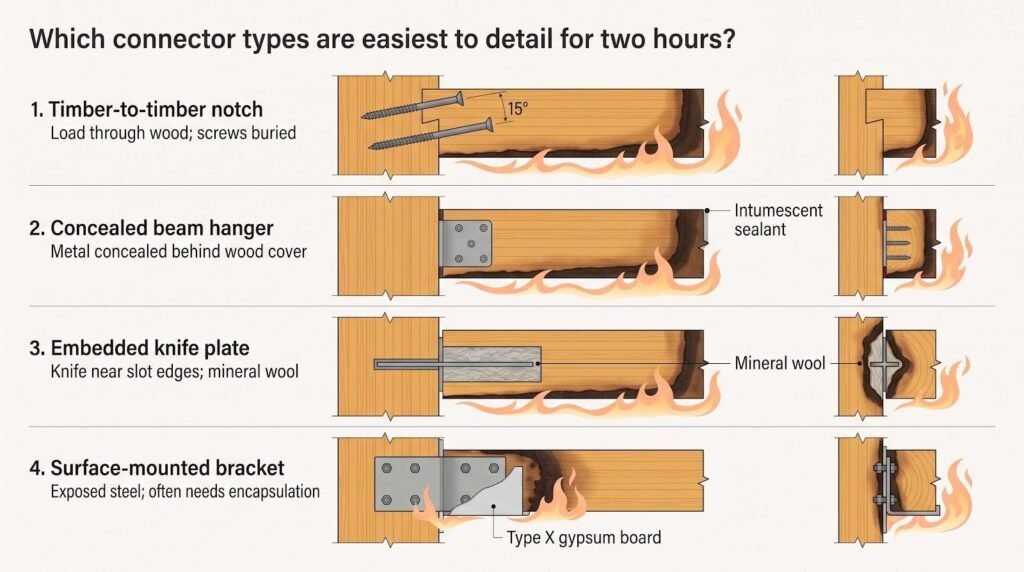
- Timber-to-timber bearing notches. The load travels through wood, so the steel stays cool. Designers can often reach two hours by calculation.
- Concealed beam hangers. Plates sit inside the member. Keep the tested wood cover and copy the tested gap treatment (an intumescent seal, or the APEX no-sealant detail).
- Embedded knife plates. Slots let heat in at the edges. Plan generous side cover and fill voids, or the plate heats too quickly.
- Surface-mounted brackets or exposed bolts. Unprotected steel heats fast once flames reach it. Encapsulation with Type X gypsum can work, but it hides the timber and adds labor.
Rule of thumb: more wood between flame and fastener means a simpler path to a two-hour approval.
Fire detailing variables that can invalidate a test report
Treat the furnace report like a contract; change any clause and the two-hour promise disappears.
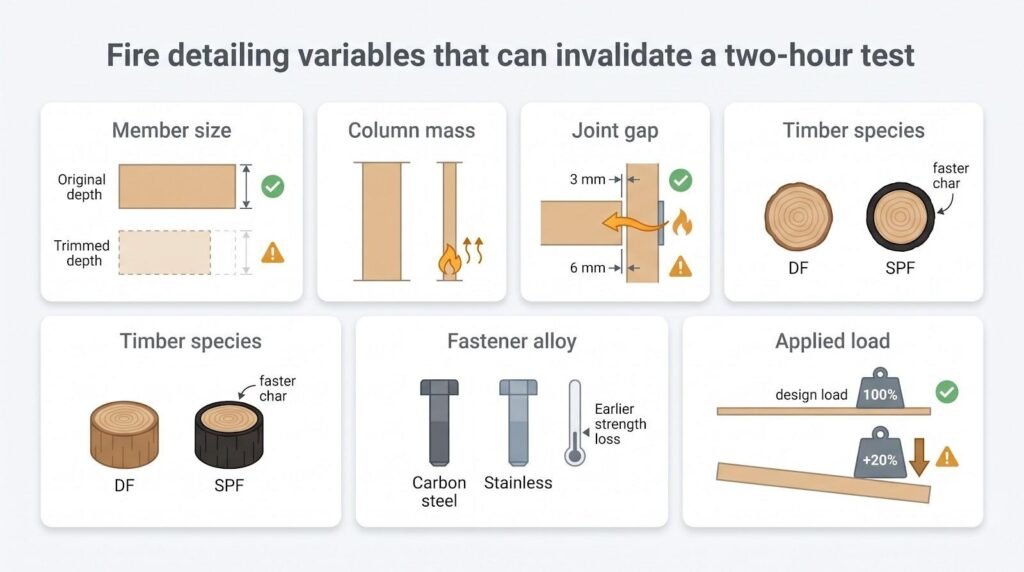
- Member size: the test used specific beam and column sizes. Smaller members heat through faster.
- Joint gap: the tested gap and seal detail control how much hot gas reaches the connector.
- Timber species: different species char at different rates, so check the residual section if you switch.
- Wood cover: the tested side and bottom cover is a minimum, not a target.
- Applied load: furnace tests run at a set design load. A late load increase can take you outside the tested range.
A three-hour first: Neutral’s Edison project
In spring 2025, developer Neutral tested a hybrid mass timber assembly with standard connectors for a 3-hour fire-resistance rating at SwRI in San Antonio, for its Edison tower in Milwaukee, and published the results for free use by the industry. The project team said many standard connection configurations had never been tested for 3 hours. If you need more than two hours, ask manufacturers whether a project test already exists; you might inherit a ready-made data package and skip a costly new burn.
Procurement questions to ask up front
- Stock and lead time. Ask whether your sizes are stocked in North America or made to order.
- Complete RFQ data. Give beam size, species, coating, and target fire rating so vendors can price screws, seals, and accessories in one quote.
- Installation labor. Factory-installed screws and slide-in hangers cut field hours; routed pockets shift cost from hardware to CNC time.
Conclusion
Treat fire, seismic drift, and durability as one design problem. Choose a connector whose fire test also covers the drift and gap conditions on your project, check the post-char section early, and combine inspection checklists so one site visit confirms screw angles, gap seals, and cover. Teams that settle these choices at schematic design avoid late rework and permit delays.
 Decor Drip