
Fluted fronts are everywhere—from kitchen islands to shower glass—but they truly shine when a space-starved bath needs a style upgrade. According to the 2024 U.S. Houzz Bathroom Trends Study, wood-tone vanities now edge out white (26 percent versus 22 percent), confirming that homeowners crave warmth and texture even in tight quarters.
Ahead, you’ll find the key measurements to take, materials that thrive in humidity, and the eight vanities that outperformed the rest in our space-efficiency tests—from budget finds to splurge-worthy pieces.
How to choose the right fluted vanity for a small bathroom
Before we start handing out awards, let’s pin down what “best” truly means in a space the size of a walk-in closet. You and I care about three things above all: does the vanity fit, does it function, and will it stay gorgeous after years of steamy showers.
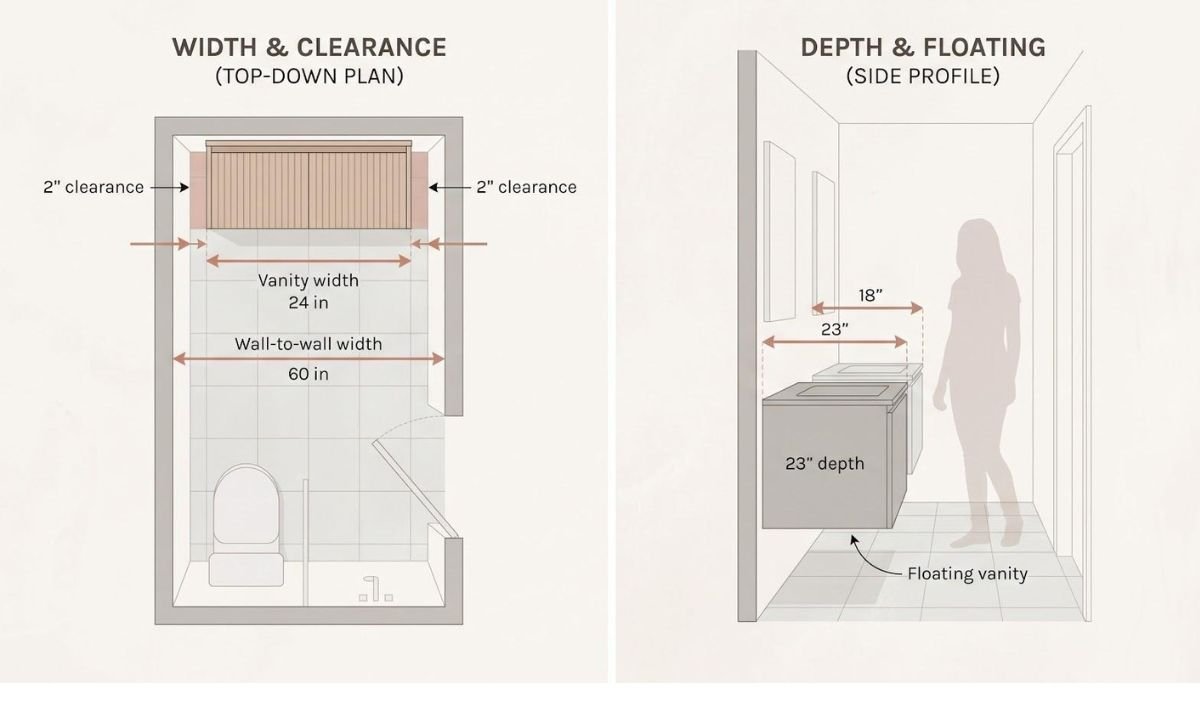
The fit question is ruthless. Measure wall to wall, then subtract at least two inches on each side so drawers don’t clip the tile. Depth matters just as much; in a galley bath a 23-inch cabinet can feel like a barricade, while an 18-inch profile leaves breathing room. Float the vanity and the floor stretches visually under it; the whole room feels lighter, a trick designers rely on constantly.
Function lives or dies on storage. Drawers beat swing doors because they slide toward you; no awkward crouching. In our scoring, storage carries the most weight (25 percent) because a powder room without a linen closet needs every cubic inch. Look for smart plumbing cut-outs or U-shaped drawers that dodge the drain and reclaim space most vanities waste.
Material keeps the story short or painfully long. According to Giving Tree Home, a well-maintained solid wood vanity lasts 15 to 25 years, far outpacing standard veneer units that typically last 5 to 10 years. MDF wrapped in laminate costs less but needs strict ventilation; one damp winter and edges may puff.
Design isn’t just “pretty.” Vertical grooves draw the eye up, adding height, while light finishes bounce illumination around the room. Dark walnut can feel luxurious, but in a windowless bath it may read heavy unless you offset it with a bright counter and large mirror.
Installation rounds out our rubric. A pre-assembled unit saves headaches if your doorway is wide enough; a flat-pack travels up attic stairs but costs you an evening with an Allen key. For wall mounts, look for steel hanging brackets and confirm stud locations before you fall in love online.
Scorecard ready, we can meet the models that check these boxes instead of missing by a mile.
1. Willow Bath and Vanity “Parker” 24-inch – best overall for small spaces
Think of Parker as the Swiss Army knife of compact vanities. At just 24 inches wide and roughly 22 inches deep, it slips into nearly any nook yet still feels like real furniture, not a scaled-down box. The body is solid mango or teak, both fast-growing, humidity-resistant woods that keep doors square and grooves crisp; these same sustainable materials appear across the wider fluted collection from Willow Bath and Vanity.
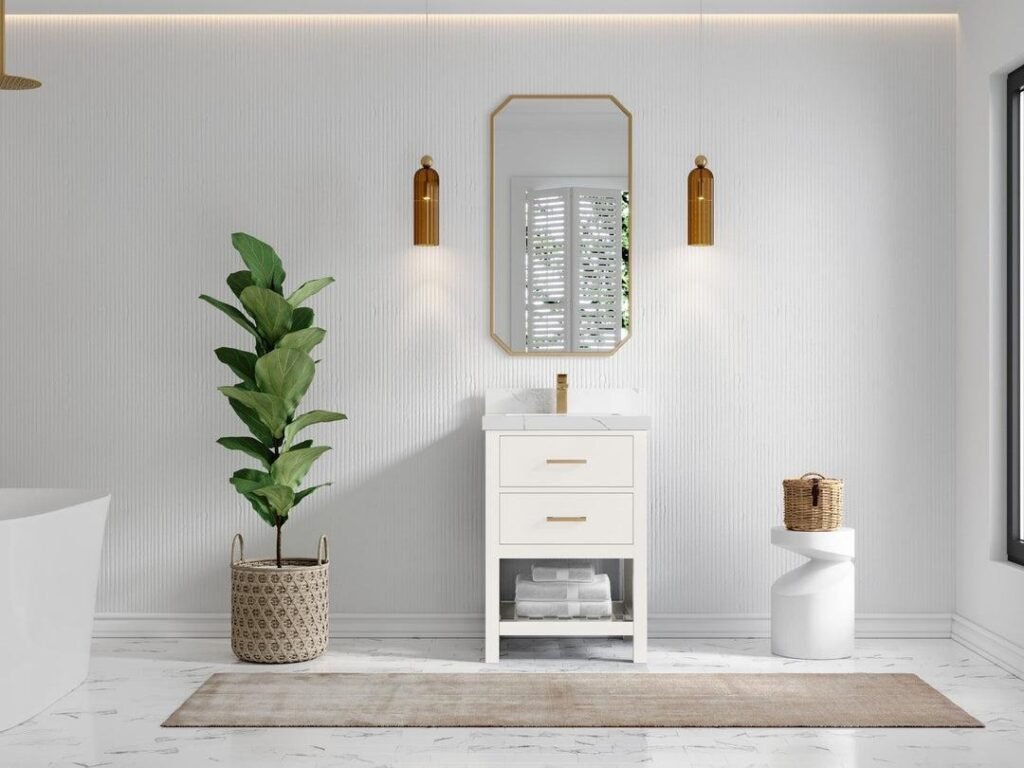
Open the doors and you’ll see a full-width interior shelf that handles hand towels or extra tissue. Because plumbing hugs the back wall, every inch up front stays usable, a rarity at this size. Tall legs lift the cabinet off the floor, letting tile run underneath and visually widening the room.
Finishes range from natural teak to warm walnut, each sealed with a clear, low-VOC topcoat. Pair the cabinet with any 25-inch countertop; quartz or marble adds luxury, while a simple ceramic top keeps the budget under four figures.
Assembly is nonexistent. Parker ships fully built, so installation comes down to leveling, anchoring to studs, and setting the faucet. For renters or serial remodelers, the solid-wood frame can be sanded and refinished when tastes change, giving longevity that rivals pieces twice the price.
The takeaway: if you need one purchase that nails fit, function, and finish, Parker sets the bar.
2. James Martin “Myrrin” 36-inch – best luxury for compact primary baths
If Parker is the everyday hero, Myrrin is the scene-stealing celebrity dressed in walnut and brass. At 36 inches wide it still suits a modest floor plan, yet every detail whispers “furniture gallery.” Drawer faces are solid walnut, vertically fluted and hand finished so grain and groove align. Pull one open and dovetail joinery glides shut without a wobble or slam.
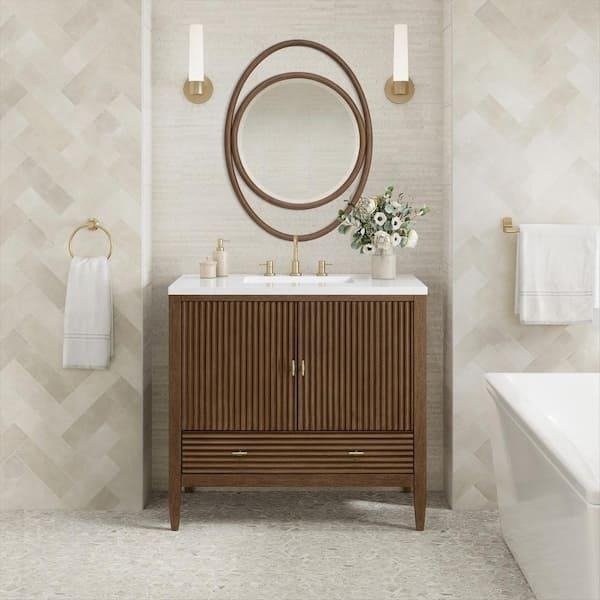
Storage rivals much larger cabinets. Two shallow top drawers corral toothbrushes and makeup, while a deeper third drawer swallows hair tools. Behind a right-side door, James Martin hides a power bar with two outlets and USB ports so cords never clutter the counter.
According to Giving Tree Home, properly maintained units last 15 – 25 years in humid baths, far outpacing MDF or veneer pieces that often fail after 5 – 10 years. Finish options include natural walnut, bright white, and carbon oak, all sealed for moisture.
Installation stays straightforward because the cabinet ships fully assembled. At 23.5 inches deep it fits standard plumbing, and adjustable levelers tame uneven floors. Pair it with the maker’s quartz top or choose marble; the pre-cut deck accepts a widespread faucet.
Myrrin starts around $3,000, but if you want couture craftsmanship in a footprint that still leaves room to towel off, nothing else on our list feels—or functions—quite this opulent.
3. Modway “Vernon” 30-inch – best budget-friendly pick
Need a style upgrade that won’t torch the reno budget? Vernon delivers fluted texture for about $600 (sink included). The cabinet is handcrafted from solid mango wood, a hardwood that shrugs off bathroom humidity.
At 30 inches wide and only 18 inches deep, Vernon offers a full counter without crowding a narrow bath. The integrated porcelain top arrives pre-drilled for a single-hole faucet, saving both shopping time and installation steps. Inside, soft-close doors reveal one large compartment—roomy enough for stacked towels or a small trash can.
Assembly happens on your living-room floor with an Allen key and clear diagrams. Once built, the unit bolts to the wall like any freestanding vanity; owners report a two-hour install even for first-time DIYers. Swap the stock chrome knobs for brass or matte black and the vanity looks far pricier than its invoice.
Bottom line: Vernon offers genuine solid wood construction, decent storage, and a painless install at an entry-level cost.
4. Restoration Hardware “Genevieve” 36-inch – best high-end statement piece
Genevieve is less a vanity, more a hand-crafted art piece that happens to hold a sink. Each vertical reed is solid European oak, set one by one by RH artisans, then finished in light, natural, brown, or black oak. The result feels like a Paris flea-market antique, only built for modern moisture.
At 36 inches wide yet just 20 inches deep, the cabinet slips into small baths where deeper luxury pieces would jut out. Doors open to a single shelf; storage is adequate for a powder room or minimalist ensuite. The top is sold separately, which is a plus: pick marble, quartz, or concrete and drill for wall-mount faucets if counter space is tight.
Tapered legs lift the frame, showing off vintage curves that echo the fluting. Add soft under-cabinet lighting and the vanity appears to float, expanding visual floor space. Installation is simple because the cabinet arrives assembled, though the oak carcass is heavy—recruit a helper.
The price hovers around $7,000, but you’re paying for heirloom joinery and a finish that can be re-oiled decades from now. If your small bath doubles as a showpiece for guests, Genevieve earns compliments before the water even runs.
5. Lacava “Flutti” 24-inch wall-mount – best space-saving floating option
When floor space feels postage-stamp small, raising the vanity is the fastest way to let the room breathe. Flutti does that with couture polish. The 24-inch box mounts flush to studs on a hidden steel cleat, so the entire floor stays visible, and the bath seems one tile wider.
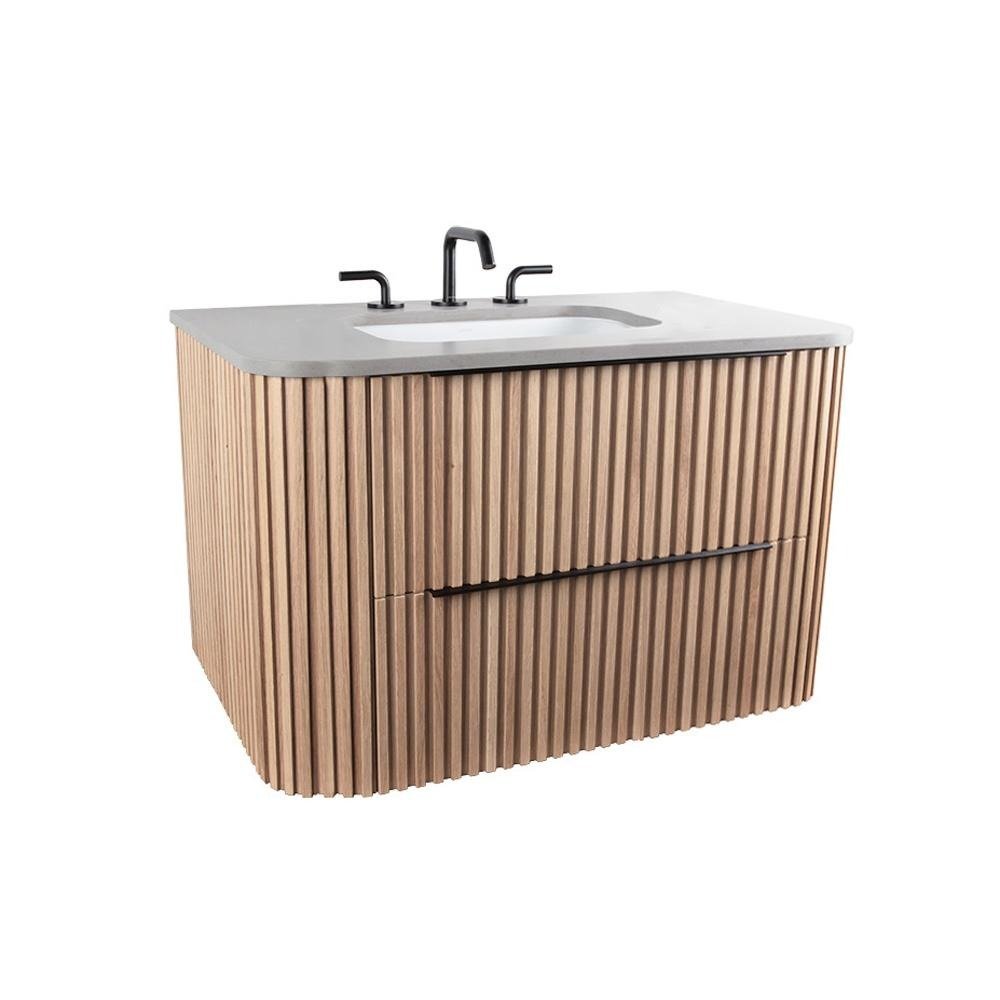
The single drawer front wears crisp, evenly spaced flutes. Behind it, a U-shaped compartment dodges the drain yet still holds everyday toiletries. Soft-close slides prevent midnight slams, and full-extension hardware lets you see every item without stooping.
Customization sets Lacava apart. Choose natural walnut veneer for warmth or one of dozens of low-sheen lacquer colors if you want the cabinet to fade into painted walls. Pair it with an integrated porcelain basin or a slim vessel sink; both project only 18 inches from the wall, so even swing doors clear with ease.
Installation takes two people: locate studs, set lag bolts, hang the cabinet, then level. The drawer lifts off its tracks in seconds, making plumbing hookup simple. Add an LED strip under the base and the vanity appears to hover, a hotel-spa trick that costs pennies but looks premium.
For tight condos, attic conversions, or anyone who craves a modern, airy vibe, Flutti shows you can have statement texture and open floor in the same square foot.
6. TileBar “Florencia” 36-inch – best mid-range all-in-one package
Florencia checks every box, then prices it sensibly. You get a fluted oak façade, a matte-black steel base that lifts the cabinet, an open shelf for rolled towels, and a factory-mounted Carrara marble top with sink—all for about $2,500.
At 36 inches wide, the vanity offers elbow room yet keeps depth to a trim 21 inches, so traffic still flows in a narrow bath. Double doors hide an interior shelf for bulky bottles, while the metal rack below holds baskets or spare tissue. That two-tier storage solves the small-bath dilemma without adding visual bulk.
The finish is warm aged oak veneer over a solid-core frame, sealed against splashes. TileBar even includes a small pot of touch-up finish for nicks. Soft-close Euro hinges feel crisp, and the marble top arrives pre-drilled for an eight-inch widespread faucet, sparing you a stone-shop run.
Setup is mostly unbox and set; only the base needs four bolts. With an open shelf, plumbing access stays wide—your installer will thank you. Because TileBar stocks limited runs in New Jersey, units often ship within two weeks, shortening remodel timelines.
Florencia lands in the Goldilocks zone: richer materials than budget kits, less sticker shock than custom work, and storage that respects real-world clutter. If you crave a balanced pick, start here.
7. Perets Design “Bali” 30-inch – best plywood value under $1,000
Bali shows that durable materials and tight budgets can coexist. For about $600 you get a cabinet built from melamine-faced plywood with no particle core. In humid rooms, plywood’s layered structure resists swelling better than standard MDF, while the melamine coating adds a water-resistant barrier.
The look is relaxed tropical: thicker flutes, tapered legs, and a convincing wood-tone finish that adds warmth without the upkeep of raw timber. At 30 inches wide and 18 inches deep, the footprint suits secondary baths yet still offers usable counter space. Two doors open to one large bay; add stackable bins if you prefer drawer-like order.
The cabinet ships without a top, so you pick the surface. A slim quartz remnant keeps the style modern; a vessel sink creates a spa vibe and preserves interior height. Seal any cut edges to protect the plywood core from steam.
Installation stays simple: level the legs, secure an L-bracket for tip safety, hook up plumbing, and you’re done. Stock can vary because Perets builds in small batches, but that small-shop approach delivers craftsmanship that feels boutique rather than factory pressed.
If you want sturdy plywood construction, fluted texture, and a price that leaves money for tile, Bali is hard to beat.
8. Custom fluted vanity from Etsy or a local carpenter – best fit for odd sizes and one-of-a-kind style
Sometimes the room dictates the vanity, not the other way around. Maybe the alcove measures 27 inches, the drain sits off-center, or you want a bold sage-green finish no catalog carries. In those moments a made-to-order fluted cabinet can be the simplest route—and can even cost less than forcing a stock unit to fit.
On Etsy, we found makers crafting solid oak or walnut vanities starting at 24 inches and scaling down to 18 or up to 42, priced between $1,500 and $2,400 depending on wood species and finish. You pick width, depth, stain color, and leg style. One shop offers a floating design with an integrated stone sink, trimmed to the quarter inch so tile lines stay perfect.
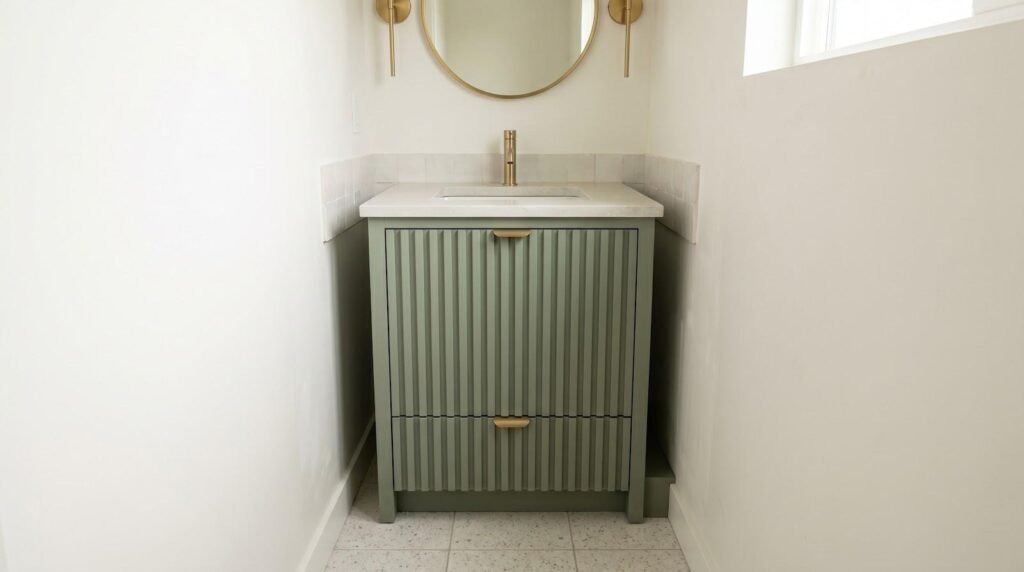
Working with a local carpenter opens the playbook wider. They can notch backs for baseboards, align drawer boxes around quirky plumbing, or build a tilt-out hamper under the sink—storage no factory spec sheet includes. Lead time runs four to eight weeks, and you handle the countertop separately, but the piece that arrives fits like a bespoke suit.
Quality varies, so vet shops as you would a contractor: look for dovetail joints, moisture-resistant finishes, and hardwood frames at least three-quarters inch thick. Ask for photos of previous bath projects and a clear warranty on warp or finish failure. Pay a deposit, not the full balance, until you see progress shots.
If every off-the-shelf option forces compromise—too wide, too deep, wrong color—custom lets you claim every inch and every shade. In a tiny bathroom where millimeters matter, that precision can feel downright luxurious.
Quick-scan comparison chart
Choosing gets easier when the numbers sit side by side: the chart below condenses our eight finalists by size, storage style, core material, and price. Scan for the row that matches your space, then jump back to the deep-dive review for the story behind the stats.
| Model | Widths (in.) | Depth (in.) | Storage layout | Core material | Price (USD) | Ideal for |
| Willow “Parker” | 24 / 30 / 36 / 42 | 22 | 2 doors + shelf (drawers on 30–42) | Solid mango or teak | 925–1,600 | Any small bath, eco-friendly budgets |
| James Martin “Myrrin” | 36 | 23.5 | 3 drawers + 1 door | Solid walnut front, poplar frame | 3,000+ | Compact primary baths, tech perks |
| Modway “Vernon” | 30 | 18 | 2 doors, open interior | Solid mango wood | about 600 (sink incl.) | Guest baths, rentals |
| RH “Genevieve” | 36 | 20 | 2 doors + shelf | Solid European oak | about 7,000 (cabinet) | Luxe powder rooms |
| Lacava “Flutti” (wall) | 24 | 18 | 1 deep drawer | Walnut veneer or lacquered MDF | 2,800+ | Ultra-tight modern spaces |
| TileBar “Florencia” | 36 | 21 | 2 doors + interior shelf + open base shelf | Oak veneer on plywood, steel frame | about 2,500 (top incl.) | Mid-range remodels |
| Perets “Bali” | 30 | 18 | 2 doors, open interior | Melamine plywood | about 619 (cabinet) | Budget value hunters |
| Custom (Etsy or local) | 18–42 | Varies | Custom fit | Solid oak, walnut, or choice | 1,500–3,000 | Odd alcoves, unique colors |
Widths list the smallest size available for each line; larger options exist but still cap at 42 inches to keep our small-bath focus intact.
Use this chart as a cheat sheet. Once you spot the models that fit both wall space and wallet, circle back to the detailed reviews for drawer hardware, lead times, and installation quirks.
Small-bath buying guide and care tips
Measure first, shop second. Tape the vanity footprint on the floor, then open a drawer box or a cardboard mock-up to be sure doors, knees, and shower glass all clear. Leave at least two inches between the cabinet side and the wall so fluted ribs will not scrape paint.
Depth is the silent space killer. Standard vanities run 21–23 inches, yet many small baths feel roomier with an 18-inch model or a wall-hung unit. Designers back floating vanities for a reason: “A floating vanity mounts directly to the wall instead of resting on the floor, exposing more visible flooring. This simple trick creates the illusion of a larger room,” notes the Bertch Cabinet design guide.
Think through storage style. Drawers cost more but pay off every morning, removing the need to crouch for toothpaste. If you choose a two-door cabinet, budget for stackable bins so items do not swallow each other in the dark. For plumbing that exits the floor, confirm the back panel is open or easy to cut; otherwise, you will spend half the installation rerouting pipes.
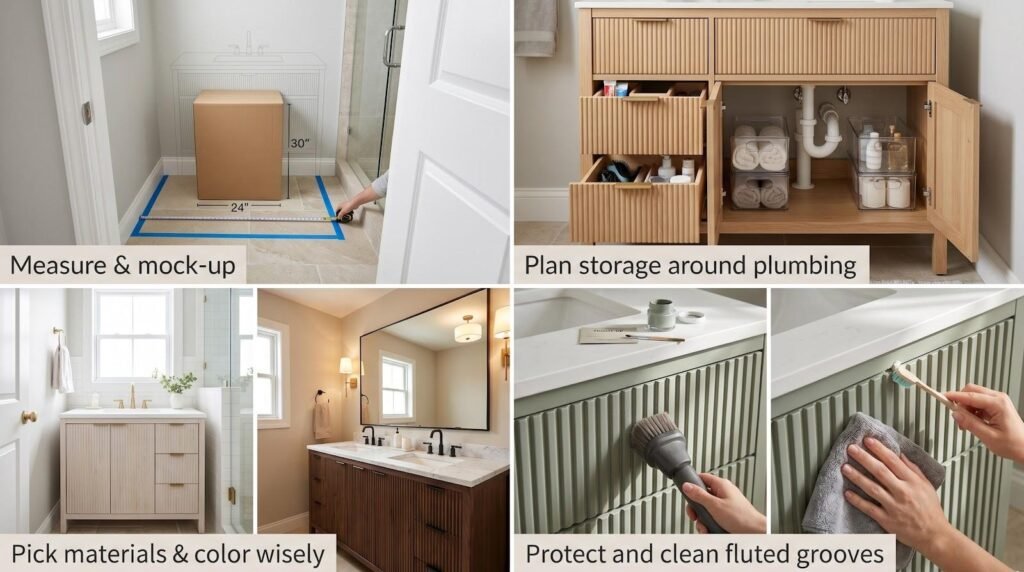
Materials decide longevity. According to Giving Tree Home, a well-maintained solid wood vanity lasts 15 to 25 years, far outpacing MDF units that often fail after 5 to 10 years. Hardwood costs more, yet you can refinish it decades later, while swollen MDF heads to the landfill. If you buy laminate, seal every edge with clear caulk and run the exhaust fan after showers.
Finish and color change how large the room feels. Light oak, whitewash, or pastel paint bounces light and lets grooves cast soft shadows. Dark walnut or black oak adds drama but can make a windowless powder room feel tight unless you balance it with a bright counter and a large mirror.
Installation shortcuts lower stress. Pre-assembled cabinets speed the job, but watch doorway width; flat-packs navigate tight halls yet demand patient assembly. For floating models, use the supplied steel cleat and secure at least two studs, because even solid wood can pull screws from drywall if someone leans on the sink.
Protect those grooves. Dust weekly with a soft brush attachment, then wipe with a damp microfiber cloth. For deeper cleanups, use an old toothbrush on corners and skip abrasives that could shear ridge edges. Painted flutes chip faster than stained wood, so keep a small pot of touch-up paint on hand.
 Decor Drip